Weekly planning is the process of deciding what you need to accomplish, when you will do it, and how you will use your available time before the week unfolds. A good weekly plan connects larger goals with realistic daily actions while leaving enough flexibility for unexpected events.
The goal is not to schedule every minute. Instead, effective weekly planning helps you identify priorities, protect important commitments, organize tasks, and deliberately make room for work, personal responsibilities, and recovery.
Whether you are a student, professional, parent, remote worker, entrepreneur, or simply trying to feel less overwhelmed, a weekly planning routine can give your week a clear structure without making it rigid.
This guide explains the core components of weekly planning, popular planning methods, practical strategies, essential skills, common limitations, and ways to create a weekly system that actually works.
Key Takeaways
- Weekly planning turns broad goals into specific actions by deciding what deserves attention during the next seven days.
- The best weekly plan reflects your actual time and energy, rather than assuming every available hour can be productive.
- Prioritization matters more than creating a long to-do list. A small number of meaningful priorities can be more useful than dozens of tasks.
- Time blocking, the 1-3-5 rule, the Eisenhower Matrix, and the Top 3 method can all help organize a week, but no single system works for everyone.
- Buffer time is essential. A plan with no margin can quickly collapse when meetings run late, emergencies arise, or tasks take longer than expected.
- Weekly planning should be flexible. Reassessing and adjusting the plan during the week is part of the process, not a sign of failure.
What Is Weekly Planning?
Weekly planning is a recurring process of reviewing your responsibilities, identifying priorities, allocating time, and preparing for the week ahead.
Instead of beginning Monday by reacting to whatever appears first, you create a basic roadmap in advance.
A weekly planning session might include:
- Reviewing the previous week.
- Checking upcoming appointments and deadlines.
- Capturing unfinished tasks and new commitments.
- Identifying your most important goals.
- Estimating the time required for important work.
- Placing key tasks on your calendar.
- Scheduling personal commitments and recovery.
- Leaving room for unexpected events.
- Reviewing the plan during the week and adjusting it when necessary.
The process can take anywhere from about 15 minutes to an hour, depending on the complexity of your schedule.
Weekly Planning vs. Daily Planning
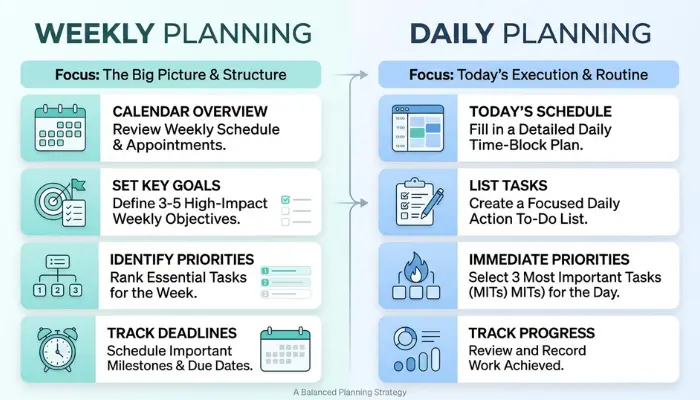
Weekly planning establishes the overall direction of the week, while daily planning determines what you will concentrate on during a particular day.
For example, your weekly plan might say:
- Finish a project proposal.
- Exercise three times.
- Prepare for Friday’s presentation.
- Pay monthly bills.
- Plan family meals.
Your Monday planning routine might then identify the specific actions needed that day.
The two systems work together. Weekly planning prevents you from losing sight of important objectives, while daily planning helps you execute them.
Weekly Review vs. Weekly Planning
A weekly review looks backward and asks what happened during the previous week.
A weekly planning session looks forward and determines what should happen next.
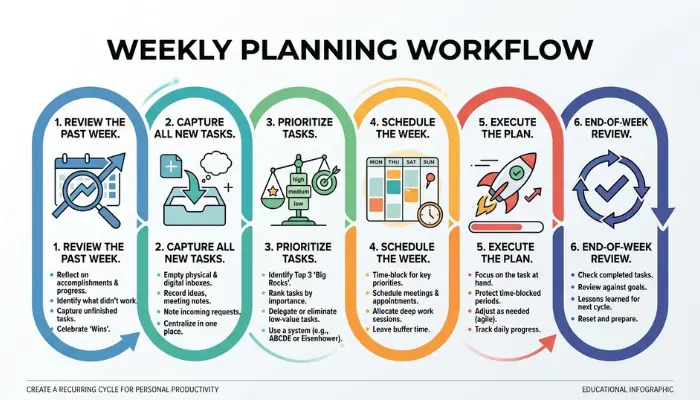
Many people combine the two into one weekly planning ritual:
Review → Clear → Prioritize → Schedule → Prepare
That simple sequence can become the foundation of a sustainable planning habit.
Why Is Weekly Planning Important?
Without a planning system, it is easy for urgent tasks to dominate your attention while important but less urgent work continues to be postponed.
Weekly planning creates a deliberate pause between one week and the next. That pause allows you to decide what deserves your time instead of simply responding to incoming demands.
It Connects Goals With Actions
A yearly or quarterly goal can feel too distant to influence your daily behavior.
Weekly planning creates a bridge.
For example:
Quarterly goal: Complete a professional certification.
Monthly objective: Finish two study modules.
Weekly action: Complete lessons 4 and 5 and schedule two study sessions.
The weekly level makes larger ambitions actionable.
It Reduces Decision-Making
A basic plan can reduce the number of decisions you have to make during a busy week.
Instead of repeatedly asking, “What should I work on now?” you have already identified your priorities and, when appropriate, assigned them a place in your schedule.
It Makes Time Constraints Visible
One of the biggest mistakes in planning is assuming that a long list of tasks can fit into a week simply because the tasks seem manageable individually.
A weekly calendar exposes the real constraint: time is limited.
If your calendar already contains work, commuting, appointments, childcare, meals, sleep, and other responsibilities, you may have considerably less discretionary time than your task list suggests.
It Can Support Work-Life Balance
A weekly plan should not consist solely of work.
Exercise, family commitments, hobbies, meals, social activities, rest, and personal appointments also consume time. Including these activities can make your plan more realistic.
It Helps Prevent Overcommitment
Planning allows you to notice conflicts before they become emergencies.
If Wednesday already contains several meetings and an evening commitment, adding another major project deadline may not be realistic.
Seeing the entire week makes trade-offs easier to identify.
The Main Components of an Effective Weekly Plan
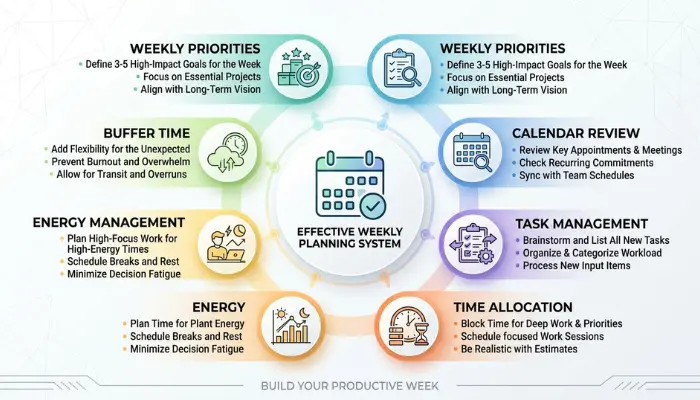
A useful weekly planning system usually contains several interconnected parts.
1. Weekly Priorities
Priorities answer the question:
What matters most this week?
Instead of treating every task as equally important, identify a small number of outcomes that would make the week successful.
These might include:
- Completing an important work deliverable.
- Preparing for an examination.
- Making progress on a personal project.
- Handling an important administrative task.
- Protecting family or personal commitments.
2. Calendar Review
Your calendar reflects commitments that already take up time.
Before adding new work, review:
- Meetings
- Appointments
- Deadlines
- Travel
- Classes
- Family commitments
- Events
- Regular routines
Looking two or three weeks ahead can also reveal approaching deadlines before they become urgent.
3. Task Management
A weekly plan needs somewhere to capture tasks that must be completed.
This could be a paper weekly planner, a spreadsheet, a notes application, a task manager, or a calendar.
The important distinction is between capturing everything and committing to everything.
Your task list can be extensive. Your weekly commitments should be more selective.
4. Time Allocation
Important tasks need available time.
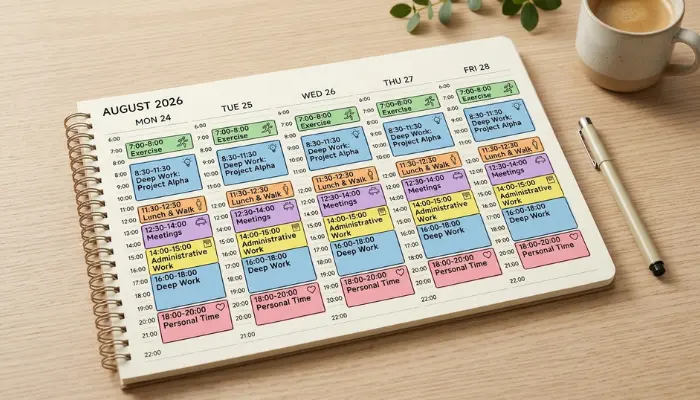
Time blocking involves assigning specific periods to categories or individual tasks. For example:
- Monday morning: project work
- Tuesday afternoon: meetings
- Wednesday morning: focused work
- Thursday: administrative tasks
- Friday afternoon: weekly review
The exact structure depends on your responsibilities.
5. Energy Management
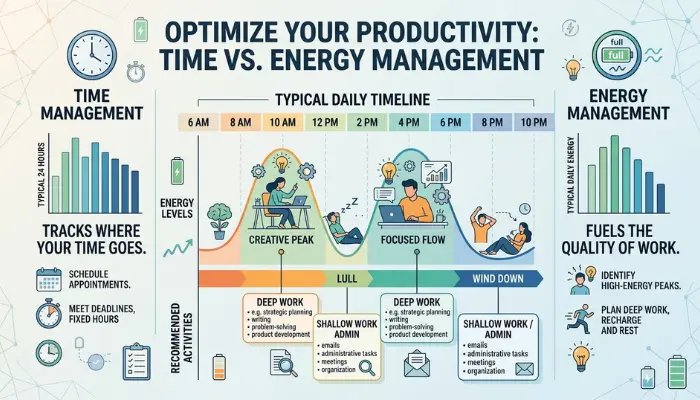
Not every hour is equally useful for every activity.
If you are most alert in the morning, demanding analytical work may fit better there. Less demanding administrative work can be placed during lower-energy periods.
This approach treats energy as another planning resource, rather than focusing exclusively on the clock.
6. Buffer and Flex Time
A plan needs margin.
Buffer time allows you to absorb:
- Delayed meetings
- Unexpected requests
- Travel problems
- Family emergencies
- Technical issues
- Tasks that take longer than estimated
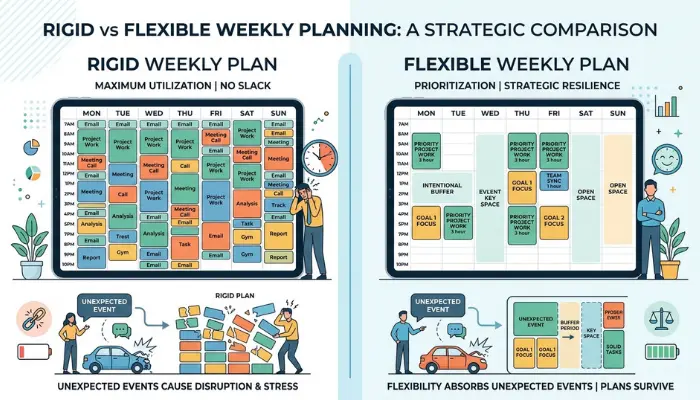
A full calendar may look efficient but can be extremely fragile.
Types of Weekly Planning Systems
There is no universally correct weekly planning method. Different approaches emphasize different aspects of organization.
Time Blocking
Time blocking divides your calendar into periods dedicated to particular activities.
Instead of maintaining only a task list, you decide when important work will happen.
Best for: People who have control over their schedules and benefit from clear structure.
Advantage: Makes time availability visible.
Limitation: Can become too rigid when your schedule changes frequently.
Top 3 Priorities
This minimalist approach identifies the three most important outcomes for the week.
You can then add smaller tasks around them.
Best for: Beginners and people who become overwhelmed by complex planning systems.
Advantage: Keeps attention on what matters most.
Limitation: Three priorities may not represent the full range of responsibilities in a complicated week.
1-3-5 Rule
The 1-3-5 method organizes tasks into:
- 1 major task
- 3 medium tasks
- 5 smaller tasks
The exact workload should be adjusted to your circumstances.
Best for: People who want a structured but relatively simple task list.
Advantage: Provides a practical limit on commitments.
Limitation: Tasks can vary dramatically in difficulty, so nine tasks do not necessarily represent a realistic workload.
Eisenhower Matrix
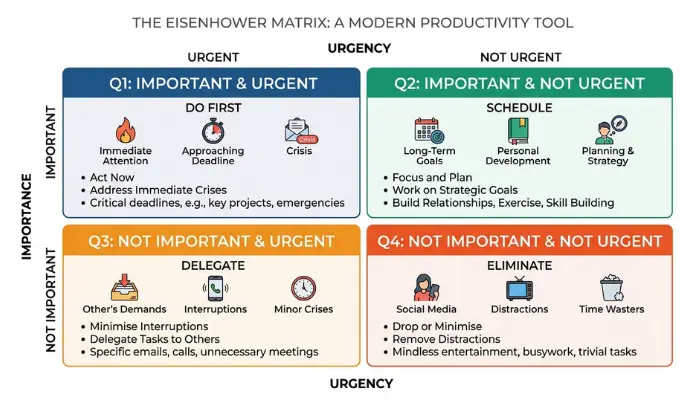
The Eisenhower Matrix categorizes tasks according to urgency and importance:
- Important and urgent
- Important but not urgent
- Urgent but less important
- Neither important nor urgent
Best for: Prioritization when your task list contains competing demands.
Advantage: Helps distinguish urgency from importance.
Limitation: Categorizing every task can become a planning exercise in itself.
Getting Things Done Weekly Review
The Getting Things Done approach emphasizes capturing commitments, clarifying what they mean, organizing them, reviewing the system, and choosing appropriate next actions.
A weekly review can help you maintain a trusted overview of your commitments.
Best for: People managing many projects or responsibilities.
Advantage: Encourages comprehensive review.
Limitation: The full methodology can feel complicated to someone seeking a minimalist system.
Theme Days
Theme days assign particular types of work to particular days.
For example:
- Monday: planning and deep work
- Tuesday: meetings
- Wednesday: creative work
- Thursday: client work
- Friday: administration and review
Best for: Entrepreneurs, creatives, and professionals with predictable responsibilities.
Advantage: Reduces unnecessary task switching.
Limitation: Difficult to maintain when urgent work regularly interrupts the schedule.
Weekly Planning Strategies That Work
1. Start With a Mind Dump
Before deciding what to do, capture everything competing for your attention.
Write down:
- Tasks
- Ideas
- Appointments
- Emails requiring responses
- Errands
- Deadlines
- Personal commitments
- Things you are worried about forgetting
This brain dump prevents your planning session from becoming a memory test.
2. Review the Previous Week
Look at your previous calendar and task list.
Ask:
- What did I complete?
- What remained unfinished?
- What consumed more time than expected?
- What should I stop doing?
- What created unnecessary stress?
- What needs to continue into the next week?
This is the foundation of a useful weekly retrospective.
3. Process Your Inboxes
Review the places where commitments accumulate.
Depending on your life, that might include:
- Notes
- Messages
- Voicemail
- Project-management tools
- Paper notes
- School platforms
You do not necessarily need to respond to everything immediately. The goal is to identify what actually requires action.
4. Check the Upcoming Calendar
Review the next week carefully and scan the following two or three weeks for major deadlines.
Look for conflicts before assigning new work.
5. Choose Your Top Priorities
Select the outcomes that deserve the most attention.
A useful test is:
If I could accomplish only a few meaningful things this week, which ones would matter most?
This helps prevent your weekly to-do list from becoming a collection of equally important tasks.
6. Match Tasks to Available Time
Estimate how long important tasks will take.
Then compare those estimates with your actual available time.
If you have five hours of discretionary time but identify eight hours of high-priority work, the solution is not simply to create a more detailed schedule.
You need to reduce, delegate, postpone, or renegotiate something.
7. Schedule Your Big Rocks First
“Big rocks” are the commitments that matter most.
Place these into your calendar before filling the remaining spaces with smaller tasks.
This prevents low-value activities from consuming the time needed for important work.
8. Schedule Non-Negotiables
Include important personal commitments alongside professional obligations.
Examples include:
- Exercise
- Family time
- Sleep
- Medical appointments
- Meals
- Religious or community commitments
- Recovery time
Planning these activities does not make them less spontaneous. It acknowledges that they require time too.
9. Add Buffer Time
Avoid planning every available hour.
Leave gaps between demanding commitments whenever possible.
Buffer time gives the plan resilience when reality does not follow your estimates.
10. Review Midweek
Your weekly plan is a working document, not a contract.
On Wednesday, for example, ask:
- What has changed?
- Which priorities remain important?
- What can be removed?
- What needs to move?
- Do I need to reduce my commitments?
Adjusting the plan early is usually better than discovering Friday that half of it was unrealistic.
Essential Weekly Planning Skills
Prioritization
Prioritization is the ability to distinguish important work from work that is merely visible or urgent.
Develop it by repeatedly asking what outcome matters most rather than simply choosing the task that arrived most recently.
Time Estimation
You need to understand how long activities actually take.
Track your estimates versus reality for several weeks. This can reveal that certain tasks consistently take longer than expected.
Calendar Management
A calendar should represent real commitments rather than an idealized version of your life.
Learn to distinguish fixed appointments from flexible work.
Decision-Making
Planning requires making choices about what not to do.
A strong weekly planner is not someone who finds room for everything. It is someone who can identify what deserves limited resources.
Adaptability
Unexpected events are inevitable.
A useful planning system should make it easy to move tasks without feeling that the entire week has failed.
Reflection
Weekly planning improves when you learn from previous weeks.
A short weekly reflection can reveal patterns such as recurring overcommitment, unnecessary meetings, or certain tasks that consistently get postponed.
How to Learn More About Weekly Planning
If you want to develop a more sophisticated planning system, explore resources from multiple perspectives rather than unthinkingly following a single productivity method.
Books and Courses
Look for educational material covering:
- Time management
- Goal setting
- Project management
- Habit formation
- Personal productivity
- Decision-making
- Work-life balance
Productivity Methodologies
Study established frameworks such as:
- Getting Things Done
- Time blocking
- The Eisenhower Matrix
- Bullet Journaling
- Pomodoro
- Goal-setting frameworks
The objective is not to adopt every method. Take the elements that solve your particular problems.
Professional and Institutional Resources
Project-management organizations, educational institutions, workplace training programs, and reputable productivity educators can provide useful frameworks for planning and prioritization.
Experimentation
One of the best ways to learn weekly planning is to test a simple system for several weeks.
Track what works and what does not.
A planning system should become easier and more useful over time, not increasingly complicated.
What Traditional Productivity Advice Can’t Teach You
Many planning systems assume that everyone has roughly the same level of control over their time.
Real life is more complicated.
A parent may have unpredictable childcare responsibilities. A healthcare worker may have changing shifts. A student may have changing class requirements. A manager may spend much of the week responding to other people.
This means a planning method that works beautifully for one person can be frustrating for another.
Your Available Time Is Not the Same as Your Theoretical Time
A calendar might show several empty hours, but those hours may be fragmented or affected by fatigue, commuting, household responsibilities, or other demands.
More Planning Is Not Always Better
Planning can become another form of procrastination.
If you spend an hour color-coding a schedule for a week that contains only a few meaningful commitments, the planning system may be consuming more resources than it saves.
Human Energy Changes
A plan can be technically realistic but psychologically unrealistic.
Two hours of concentrated work may be possible in theory but difficult after a poor night’s sleep or a demanding morning.
Some Weeks Are Simply Different
A normal workweek, vacation week, exam week, product-launch week, and family-emergency week should not necessarily use the same planning system.
The best system adapts to circumstances.
When Conventional Weekly Planning Rules May Not Apply
You Have an Unpredictable Schedule
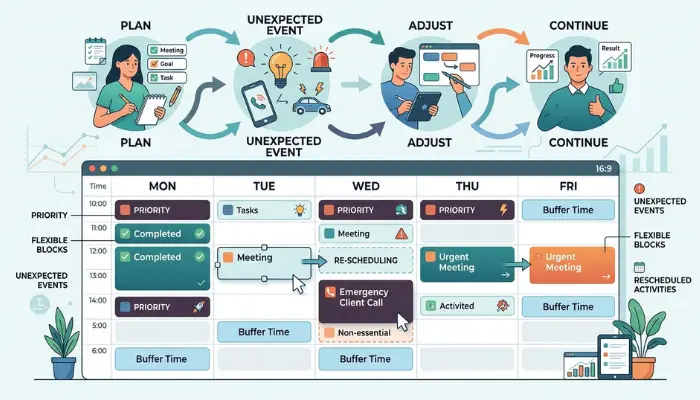
The conventional advice may be to schedule tasks into specific time blocks.
That can be difficult for people whose work or personal responsibilities change constantly.
Instead, use priority blocks or task categories.
For example, rather than saying “write from 9:00 to 11:00,” you might identify writing as the highest-priority task to complete during the next suitable two-hour window.
You Work in a Highly Reactive Role
Some jobs require immediate responses to customers, patients, clients, emergencies, or colleagues.
A rigid schedule may create unnecessary frustration.
Use a small number of protected priority periods instead of attempting to control the entire day.
You Are Overwhelmed
When your workload is already excessive, adding a complicated weekly planning ritual may make matters worse.
Start with three questions:
- What absolutely must happen?
- What can wait?
- What can be removed or delegated?
Then create the smallest workable plan.
Your Energy Varies Significantly
If your concentration changes substantially throughout the week, use energy-based planning.
Schedule demanding work during your strongest periods and simpler activities when your energy is lower.
Your Priorities Are Shared With Other People
Families and teams cannot always operate according to one person’s private schedule.
A shared weekly family calendar or a team planning session may be more effective than coordinating everything individually.
The Bottom Line
Weekly planning is a practical system for turning goals and responsibilities into a realistic plan for the next seven days. Its purpose is not to control every minute but to help you decide where your limited time, attention, and energy should go.
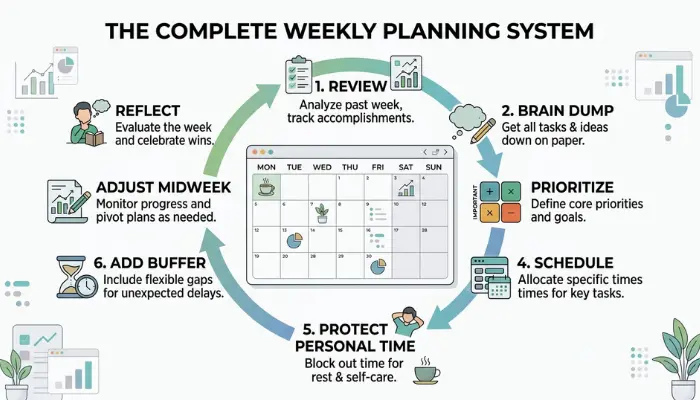
An effective weekly planning routine typically involves reviewing the previous week, checking upcoming commitments, capturing outstanding tasks, choosing priorities, scheduling important work, protecting personal commitments, and leaving room for unexpected events.
Methods such as time blocking, the Top 3 approach, the 1-3-5 rule, the Eisenhower Matrix, theme days, and the Getting Things Done weekly review can provide useful frameworks. But the best system is not necessarily the most sophisticated one.
Start with a simple weekly review and a handful of meaningful priorities. Build your schedule around actual capacity rather than wishful thinking. Include both work and life. Leave margin for reality. Then review what happened and improve the system the following week.
The most valuable weekly plan is not the one that looks perfect on Sunday. It is the one that helps you make better decisions when Monday arrives—and remains useful when the week inevitably changes.